
Hancock Court Docket Searches
Hancock offers no standalone city court docket, city court calendar, or anonymous municipal payment search. For a citation that a court directs, the practical route runs through the 97th District Court. Its MiCOURT case search is part of that route. Hancock's official code states plainly that a municipal civil-infraction citation goes to District Court. Keep the city-issued notice as your starting document. It names the alleged violation, the court location or telephone, and the response timing.
Use a citation or case number first if you have one. A Hancock name search can help. But run it against the correct court. Treat it as informational. MiCOURT itself warns that public information can be incomplete or out of date. Some categories never appear publicly. A no-result search should send you to the clerk, not to a conclusion that the matter vanished.
- Read the Hancock notice for the issuing department, citation number, alleged violation, court location, and response date or time.
- Contact Hancock City Hall or police when the issuing record itself is unclear.
- If the notice directs the matter to court, use the 97th District Court MiCOURT route by name or case number.
- Compare any case-history result with the notice, then use Court Display for a scheduled event.
- Call the District Court when the notice and online information conflict or when a permitted copy is needed.
Note: The court named on the notice, not the Hancock address of the event, sets the judicial record route.
Hancock Citations Reach District Court
Hancock's municipal civil-infraction code describes a local notice directed to District Court. Each citation is consecutively numbered. It lists the alleged violator, the alleged violation, the court location or telephone, and the appearance timing. That is the local link between a Hancock ordinance matter and a 97th District Court docket. It does not build a separate Hancock court database.
Read the notice closely. A city ordinance issue, a parking matter, and a state traffic citation can each carry different instructions. Once the notice points to 97th District Court, that court holds the judicial case history. The public D97 path is MiCOURT's court-specific selector. The District Court can be reached at 906-482-4980 if the online search leaves the routing question open.
| Record clue | What it signals | Next Hancock action |
|---|---|---|
| City department or ordinance notice | A city-held issuing or administrative record may exist | Ask City Hall or police where that notice is maintained |
| District Court location, phone, or appearance time | A court-directed municipal civil infraction | Use D97, MiCOURT, and the District Court clerk |
| Case number and public case history | A court-maintained judicial record | Check the history and request permitted copies from the court |
This route is why "city citation" and "city court record" are not interchangeable terms in Hancock. The city starts or administers some local matters. The contested Hancock court case, though, follows the court named on the citation.
Inside the Hancock Municipal Court
Hancock's official local material shows no standalone municipal court. There is no municipal court clerk, city docket viewer, or judicial calendar. The best reading is that city administration and the Ordinance Violations Bureau handle notice-level work. Contested municipal civil infractions go to 97th District Court. Calling a city counter a "Hancock Municipal Court" would misstate the published record path.
Hancock City Hall can help you identify the issuing office or a city-held record. It cannot certify a 97th District Court case history. Once a cited Hancock matter uses the district-court path, the 97th District Court is the court record holder. A circuit-level case arising in Hancock stays with county judicial routes, the court and the County Clerk. No Hancock municipal function holds it.
That boundary also prevents a common search error. A city website can be authoritative on services and code enforcement. Yet it may offer no court docket search at all. The court name and case number determine the correct judicial search.
Hancock Hearing Choice Terms
Hancock's code supplies practical terms for answering a municipal civil-infraction citation. Your options include admitting responsibility, admitting with an explanation, or denying responsibility. Informal and formal hearing routes are also available. Each is a response choice tied to the citation and court procedure. None of it amounts to a generic instruction to "fight a ticket."
- Admit responsibility
- A response option identified in the Hancock code. The notice and court instructions control the consequences and timing.
- Admit with explanation
- A separate code-listed choice that allows an explanation within the citation process.
- Deny responsibility
- A response that leads toward the applicable hearing path described by the code and citation.
- Informal hearing
- One of the hearing routes named in the Hancock municipal civil-infraction provisions.
- Formal hearing
- The other code-listed hearing route; ask D97 about the scheduling and record process for the particular matter.
The Hancock response time is printed on the notice itself. No universal deadline should replace it. Follow the directions on the citation, and contact D97 whenever the instructions seem unclear.
Finding Hancock Court Dates
A Hancock court date is ordinarily found through the court path. It is not on a city meeting calendar. MiCOURT Court Display offers a public setting view. Its fields include Party Name, Time, Room, and Case Number. It works well as a second check after the case history. The interface warns that not all hearings appear. Some information is nonpublic. So the paper notice and District Court confirmation still matter.
| Party Name | A public display field that helps match an event, subject to privacy and publication limits. |
|---|---|
| Time | The listed event time, which should be checked against the citation if there is a discrepancy. |
| Room | The courtroom or room field shown for a published setting. |
| Case Number | The court reference that connects the calendar row with the case history. |
| Setting status | A scheduled event, not proof that the hearing occurred or that the case is closed. |
If a Hancock notice names 97th District Court and the public calendar looks blank, call the 97th District Court about the Hancock setting before you miss it. The court name and case number help verify the matching calendar row. A blank display can mean a nonpublic event, a publication limit, a court mismatch, or a schedule change.
Hancock City Hall Police or D97
Which Hancock office to call depends on the record you want. City Hall handles the administrative side. The police can tell you which side of a notice issued it. When a contested municipal civil infraction goes to court, the District Court holds the record, so keeping these contacts straight saves a caller from explaining the same question twice.
Hancock City Hall
City administrative records, City Manager/FOIA routing, and city notice questions.
399 Quincy Street, Hancock, MI 49930
Hancock police
For an issuing-side question or police nonemergency routing on a city notice.
97th District Court
For a court-directed citation, case history, hearing confirmation, or court-copy request.
Hancock’s official contact directory is the source for the City Hall and police channels.

Each Hancock office plays its own role in routing a request. City Hall serves administrative needs, while the 97th District Court remains the judicial records destination whenever a Hancock citation requires a court appearance.
Hancock Traffic Ticket Lookups
Before you search or pay a Hancock traffic or ordinance ticket, classify it. Read the issuer. Then read the citation number, court location, and response instructions printed on the notice. For court-directed matters, the 97th District Court is the main Houghton County traffic-court source. MiCOURT offers a public case-history lead. Court Display can help confirm a setting. Whatever the notice says about the deadline controls your response time.
Michigan's ePAY system offers several official ticket-search paths. Not every Houghton County ticket appears there. A missing ePAY result does not mean a Hancock notice stopped being pending. Maybe the notice names the court. Maybe payment and hearing choices seem unclear. In either case, contact D97. The Houghton County traffic court page gives the countywide court-record context.
Paying a Hancock ticket through the official statewide process can carry legal consequences. Someone who wants a hearing should follow the citation instructions rather than assume any online payment page fits the specific notice.
Hancock Ordinance Bureau and D97
Hancock may run an Ordinance Violations Bureau for its notices. That bureau is not the 97th District Court. The city code's direction toward District Court is the dividing line. The bureau can matter for a city notice or payment route, while a denial or hearing request moves along the code and citation procedure into the district-court path.
| Hancock channel | Typical purpose | What it does not replace |
|---|---|---|
| Ordinance Violations Bureau | City notice-level administration where the city uses that channel | A District Court hearing or docket history |
| City Hall or police | Issuing-office and city-record questions | Certification of a court case file |
| 97th District Court | Contested municipal civil-infraction record and hearing route | A substitute for the city’s administrative record |
The point is not to pick a favorite Hancock office. Follow the record holder. A city employee may clarify who issued a notice. The Hancock court clerk, in turn, can explain how to get a court case history or a permitted copy.
How Hancock Cases Reach the County
Hancock cases reach the county courts in specific ways. The notice, citation, filing, and jurisdiction put them there. Contested municipal civil infractions go to 97th District Court under Hancock's official code. District Court also handles traffic matters and civil infractions. It takes misdemeanors within district jurisdiction too. District civil cases and small claims round out its docket. Matters in circuit jurisdiction run through the 12th Circuit Court and County Clerk structure.
Docket flow: Hancock city notice › 97th District Court when the citation directs a court case › 12th Circuit Court for matters within circuit jurisdiction.
This route does not turn every Hancock city action into a court case. It simply shows where to look once a notice sends you to court. For a broader name-or-number lookup, the Houghton County docket search is the right stop after you know the judicial office.
Hancock City Record or Court File
Need a city record rather than a court file? Start with the Hancock FOIA route. City-held material can include an ordinance. It can also include meeting records, a police or administrative record, or anything else the city keeps. The FOIA request form asks for names, date, location, the specific information sought, delivery preference, and a signature. Those fields help the city find its own material.
A District Court case history, judicial filing, transcript, or certified copy belongs to the court record route instead. A Hancock clerk or police employee can explain the issuing side of a notice. That person cannot certify a District Court docket. When asking the court, give the case number if you have it. Add the record type and a date range.
Note: A city FOIA form covers city administrative material only. It does not replace a request under Michigan court-record rules.
Who Can See Hancock Court Records
Michigan court rules govern public access to Hancock-area court records. MCR 8.119 generally allows public inspection and copying. Access shrinks only when a statute, court rule, administrative order, or court order limits it. Online, you can usually see case numbers, party names, and case history. Not every public filing gets an online image.
Some Hancock court categories stay restricted or off the public portal. A docket entry may show without a downloadable document. A blank search does not prove a case never existed. The maintaining clerk can explain the options. Those cover inspection, a redacted copy, a plain copy, certification, or a restricted-record process.
Access boundary: Hancock city FOIA covers city administrative records, while a court-file request follows MCR 8.119 through the court that maintains the case.
Use the court name and case number when asking the clerk about a public court record or an access limitation.
Hancock FOIA Records Doorway
Hancock's FOIA materials point to City Hall as the administrative records doorway. It is not a court-case search desk. That distinction matters most for ordinance issues. The city may hold the ordinance, notice, or administrative file. The District Court holds the contested case history. Name the exact record so the request does not land with the wrong office.
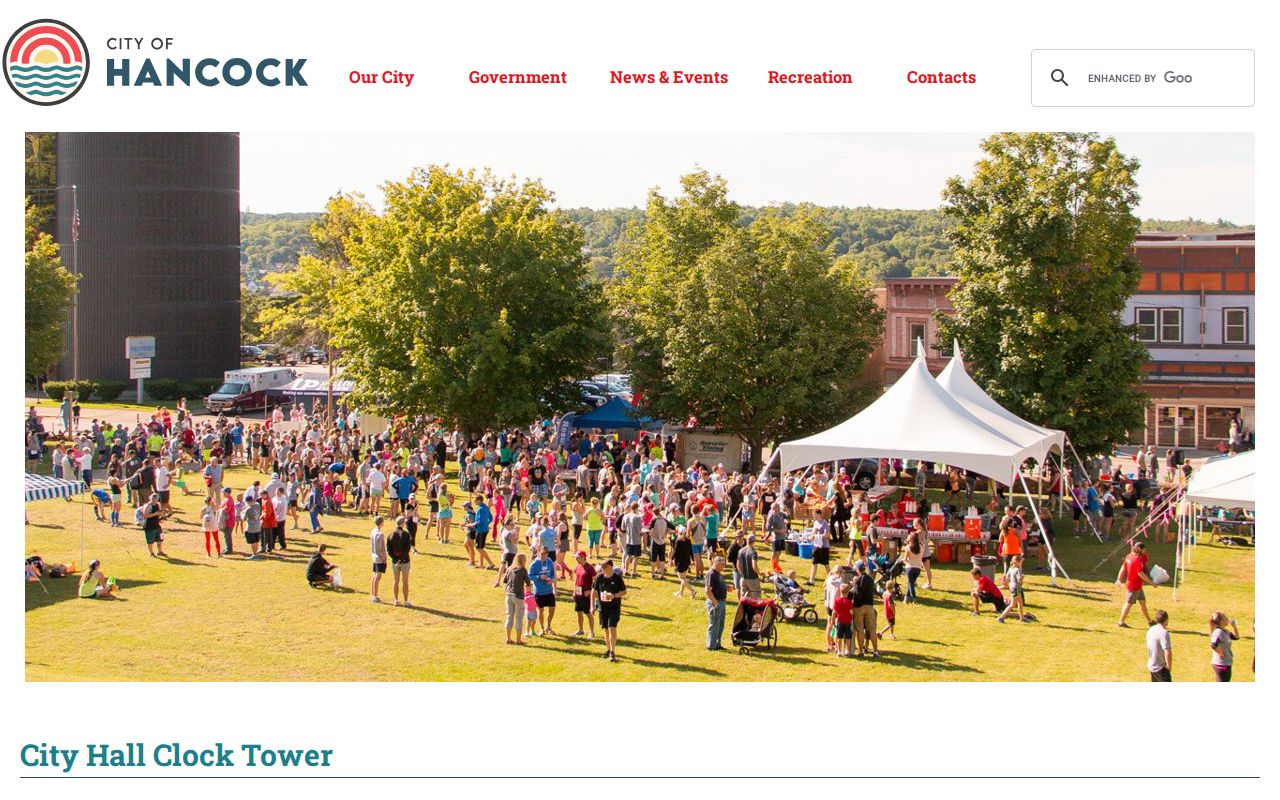
Hancock's official City Hall visual shows the building that serves as the municipal administrative records doorway.
Hancock keeps two record routes separate. City Hall holds the municipal records. Hancock court records stay with the court that filed them. So a request for judicial copies goes to the clerk of court, not City Hall. Both sit in the same town, but that does not change where the papers live.
The city's size explains why its footprint stays small. The 2020 Census incorporated-place table counts 4,501 residents in Hancock. That makes it the county's second incorporated city. Houghton is the only other one. Every remaining place nearby is a village, with no separate city court system.